
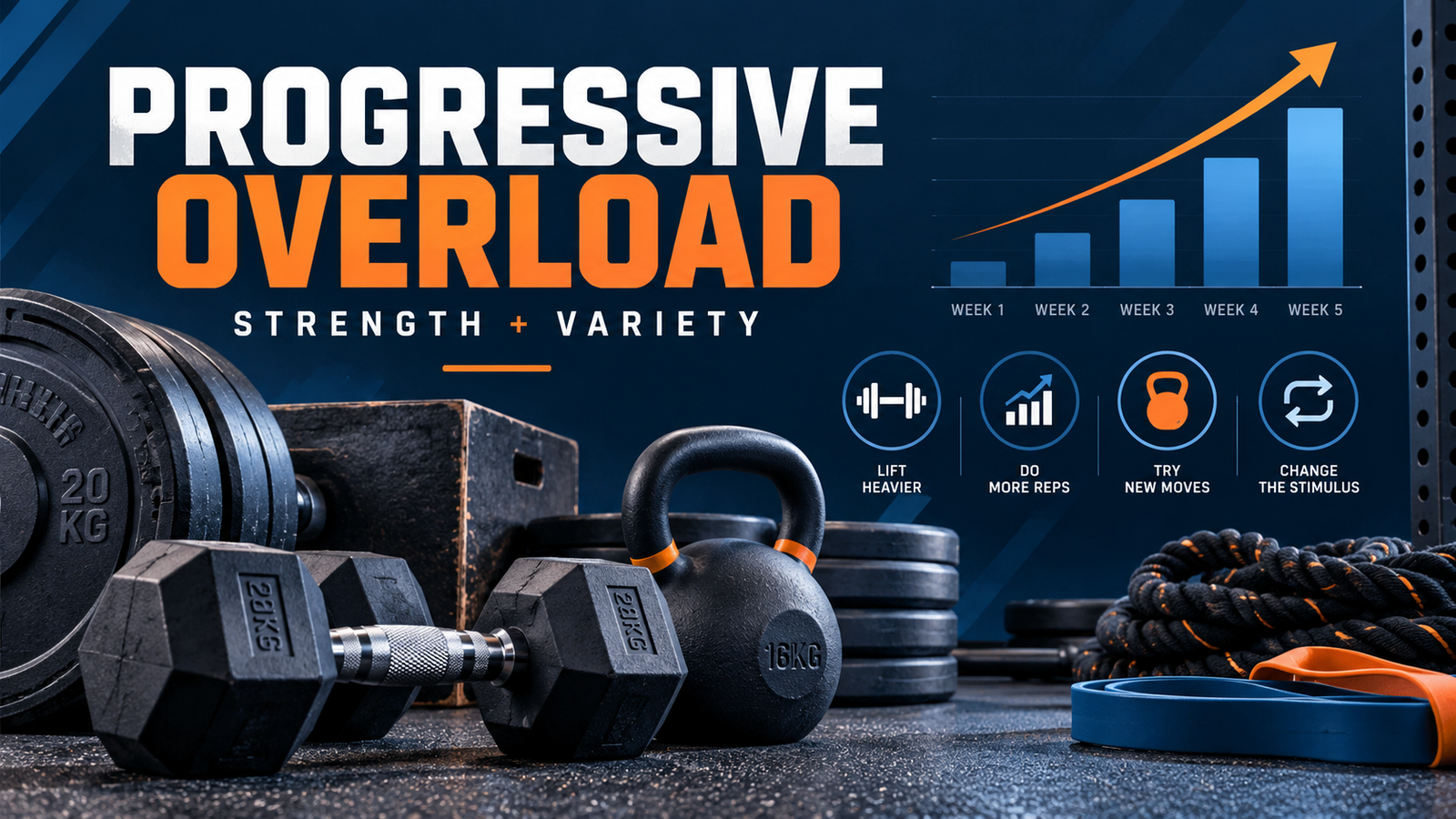
A new workout can be fun. It can also make progress hard to see if every exercise, weight and rep range changes at once. On the other hand, repeating exactly the same session forever is not a requirement for getting stronger. The useful question is: Are you giving your muscles a reason to adapt, and can you tell whether you are improving?
What progressive overload actually means
Progressive overload means gradually increasing the training demand as you become capable of more. That may be a heavier dumbbell, another repetition with the same weight, an additional set, or a harder version of a bodyweight exercise. It does not mean adding weight every time you train or turning each workout into a maximal effort.
For example, suppose you can do two sets of eight goblet squats with a weight that feels challenging and good technique. Over the following sessions, you might build toward two sets of 10 or 12. When that feels controlled, try the next available dumbbell and work back toward the lower end of the range. That is a practical progression rule, not a prescribed pace: some weeks you will maintain, and others you will progress.
Research supports more than one way to progress. In a randomized training study, increasing either the load or the number of repetitions produced strength and muscle gains in young adults early in training. A separate eight-week study in resistance-trained participants also compared load and repetition progression. These small, relatively short studies do not establish one universal method, but they make an important point: a heavier weight is not the only sign of progress.
Does variety stop you from getting stronger?
No. Changing exercises does not erase previous adaptations, and you do not need identical workouts every week. A systematic review of exercise variation found that planned changes in exercise selection can influence strength and muscle growth. It also cautioned that excessive, random changes may compromise gains. The distinction is whether your variety serves a goal and leaves enough continuity to practice and assess progress.
The 2026 American College of Sports Medicine position stand reaches a similarly practical conclusion: resistance training works across many approaches, and complex periodization has not consistently outperformed simpler programming for healthy adults when training is appropriately progressive. It recommends shaping a plan around the person’s goals, enjoyment and ability to keep doing it.
How to build a plan you can follow
- Keep a few anchor movements. Pick exercises that cover your main goals, such as a squat or sit-to-stand, a hip hinge, a push and a pull. Repeat them often enough to learn the movement and compare similar sessions.
- Record a small amount of information. Write down the weight, sets and reps, plus how the last few repetitions felt. For a modified push-up, note the surface height as well.
- Progress one thing at a time. First aim for better control or more repetitions within your chosen range. Add resistance when the current version is manageable. Avoid treating a temporary drop during illness, poor sleep or recovery as failure.
- Use variety deliberately. Swap an uncomfortable exercise for a similar movement, alternate a few accessory exercises, or add dance, cycling or aerial practice because you enjoy them. Keep enough of your core lifts comparable to see the trend.
Two or more strength sessions each week covering the major muscle groups are a useful general target. You can begin with fewer exercises and build from there. The ACSM review found that regular resistance training improved strength and muscle size, including with home-based routines and resistance bands. The plan you can repeat is more valuable than an elaborate plan you cannot sustain.
What counts as progress when life is not linear?
A stronger row or an extra squat rep is easy to count. Other useful changes include improved range of motion, steadier balance, more confidence with a movement or returning to an exercise after a break. Track these too, especially if you are modifying training around a joint issue. If pain appears or lingers, adjust the movement and get individual guidance when needed.
Progressive overload is a direction over time, not a demand that every workout beat the last. A familiar exercise gives you a clear reference point; thoughtful variety keeps the program suited to your body and your life. Use both.
Sources
- American College of Sports Medicine. Resistance Training Prescription for Muscle Function, Hypertrophy, and Physical Performance in Healthy Adults: An Overview of Reviews. 2026.
- Does Varying Resistance Exercises Promote Superior Muscle Hypertrophy and Strength Gains? A Systematic Review. Journal of Strength and Conditioning Research. 2022.
- Effects of Resistance Training Overload Progression Protocols on Strength and Muscle Mass. 2024.
- Progressive overload without progressing load? The effects of load or repetition progression on muscular adaptations. PeerJ. 2022.