
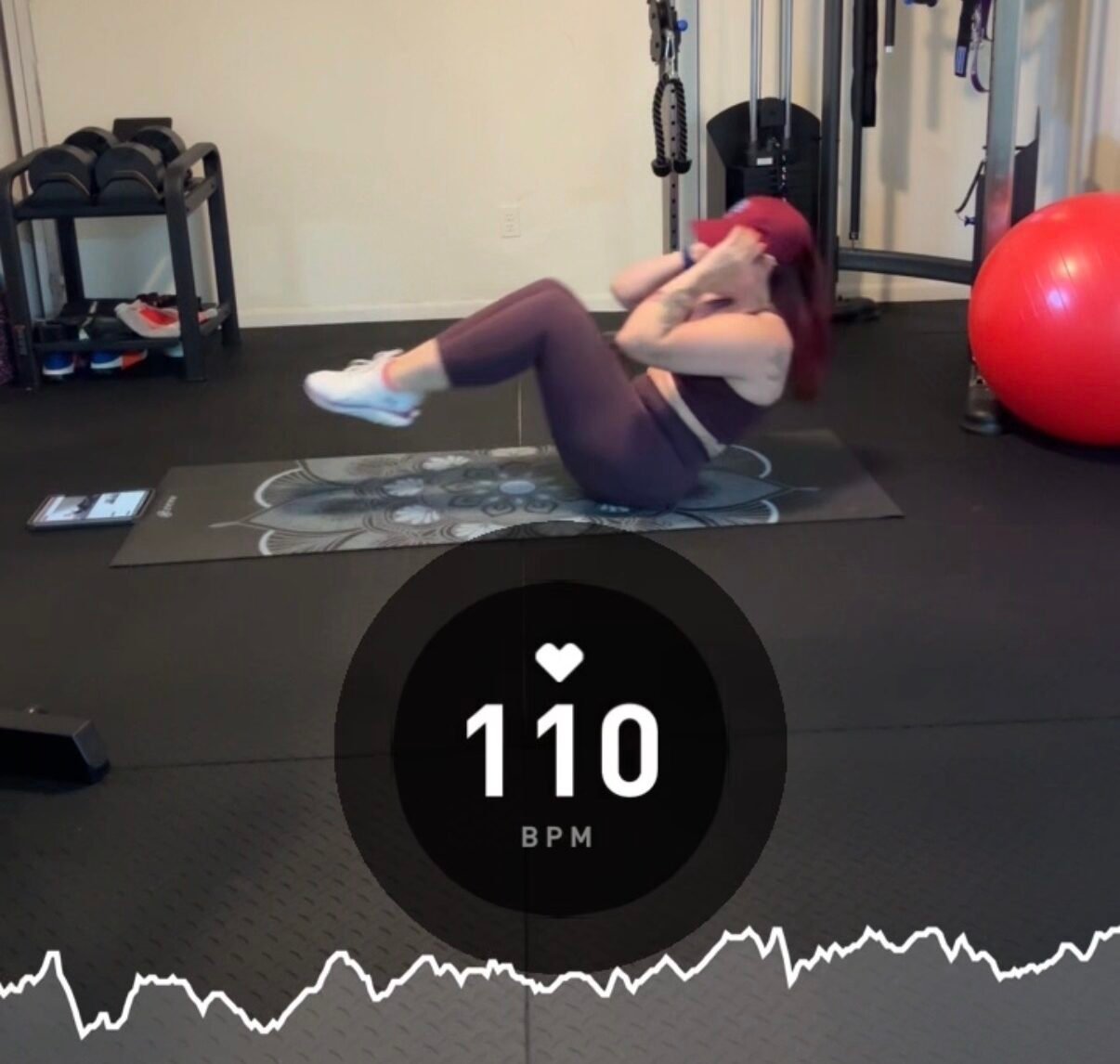
You don’t need a gym to get stronger. Resistance training at home works when two things are true: the exercise challenges your muscles, and you have a way to make it harder over time. A sturdy chair, a resistance band and your own bodyweight cover every basic movement pattern.
Below you’ll find the simple two-day plan I use with beginners, a band or bodyweight version of every exercise, and a free 4-week, 3-day program if you want more structure.
Prefer to follow along on video? My Band & Body Home Workout is completely free: no trial and no credit card, just your email.
What the evidence says
The 2026 ACSM position stand reports strength and muscle gains from home routines, resistance bands and conventional weights. The U.S. Physical Activity Guidelines recommend muscle-strengthening activity at least two days per week.
In other words, what matters is the challenge and the consistency, not the location.
What you need
- A sturdy chair or bench
- A resistance band (a light and a medium band is a good start)
- Optional: one or two dumbbells
- Enough floor space to lie down and take a step in each direction
A two-day home resistance training plan
Train on two nonconsecutive days, for example Monday and Thursday. Warm up for about five minutes, then do 2 sets of each exercise with 60–90 seconds of rest. Move with control and end the set when your form slips.
| Movement | Main exercise | Band or bodyweight option | Reps |
|---|---|---|---|
| Squat | Chair squat or sit-to-stand | Stand on the band, hands at shoulders, and squat | 8–12 |
| Hinge | Hip hinge or dumbbell Romanian deadlift | Glute bridge with a band above the knees | 8–12 |
| Push | Push-up (wall, incline or floor) | Band chest press, band anchored behind you | 6–12 |
| Pull | Supported dumbbell row | Seated band row, band around your feet | 8–12 |
| Core / carry | Loaded carry or plank | Dead bug or band Pallof press | 20–30 s or 8 per side |
The reps are a starting example, not a test. If an exercise hurts, choose an easier version, and get individual guidance when you need it.
How to use resistance bands at home
- Pick the right band: the last two reps of a set should feel hard while your form stays clean.
- Adjust the tension: step farther from the anchor or shorten the band to make it harder.
- Control the return: take 2–3 seconds to let the band back. That’s where much of the work happens.
- Check and anchor safely: look for nicks or tears before each session, and use a door anchor on the hinge side of a closed door.
Want a full 4-week program? Try Band & Body
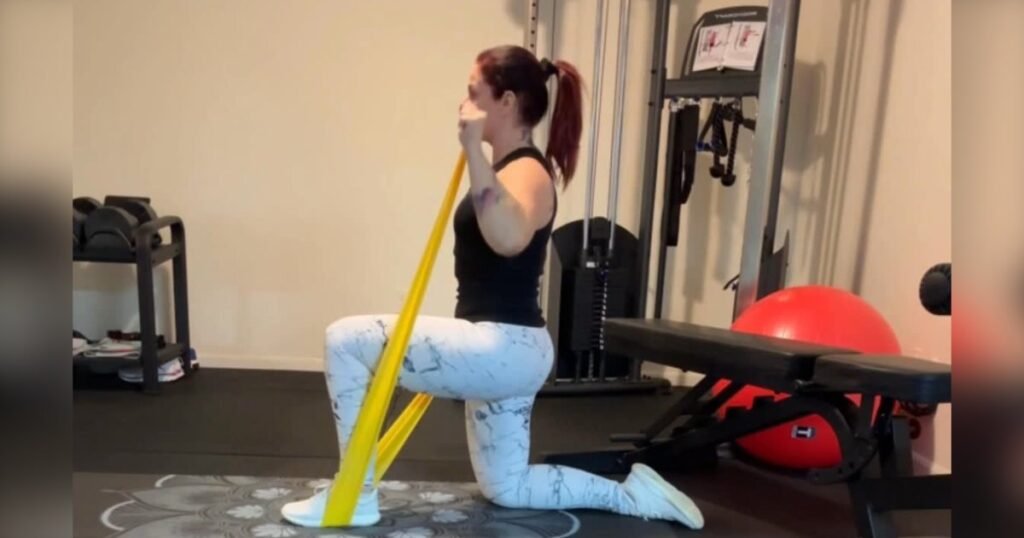
The two-day plan above is a great start. When you want more structure, my Band & Body Home Workout is a 4-week beginner program: 3 days a week, 30–45 minutes, using only your body and resistance bands. It rotates three workouts:
- Workout A: Lower Body + Active Mobility
- Workout B: Upper Body Strength & Shoulder Stability
- Workout C: Full Body
See the full program, weekly schedule and how to start in my free 4-week resistance band workout plan.
How to make a home exercise more challenging
Write down each exercise, the band or weight you used and your reps. When both sets feel controlled at the top of the rep range, progress one thing:
- Add resistance (a heavier band or dumbbell).
- Move to a harder version of the exercise.
- Add a third set.
Simple progression ladders:
- Squat: sit-to-stand → bodyweight squat → band squat → split squat
- Push: wall push-up → incline push-up → knee push-up → full push-up
- Pull: light band row → heavier band → pause for one second at the top
- Hinge: glute bridge → single-leg bridge → dumbbell Romanian deadlift
Short on time? A 20-minute option
Pick one squat, one hinge, one push and one pull. Do a couple of quality sets of each. Twenty focused minutes, repeated twice a week, will do more than an hour you can’t keep up.
Grip matters too, especially after 40. See Grip Strength After 40 for simple ways to train it at home.
FAQ
Is resistance training at home as effective as the gym?
It can be. The 2026 ACSM position stand reports strength and muscle gains from home routines and bands, as long as the work is challenging and progresses over time.
How many days a week should I do resistance training at home?
At least two days a week, in line with the U.S. Physical Activity Guidelines. Three days works well if you recover between sessions.
Can I get stronger with only resistance bands?
For most beginners, yes. Progress by using a heavier band, shortening the band, or slowing the return.
How long should a home strength workout take?
Twenty to 45 minutes is enough for most people, including the warm-up.
Is the Band & Body workout really free?
Yes. You only need your email to unlock it. There is no trial and no credit card.
The takeaway
Start with two sessions you can repeat every week. Strength comes from consistent, progressively challenging work, not from where you train. If you’re over 40, Healthy Aging After 40 explains why this matters more each year.